

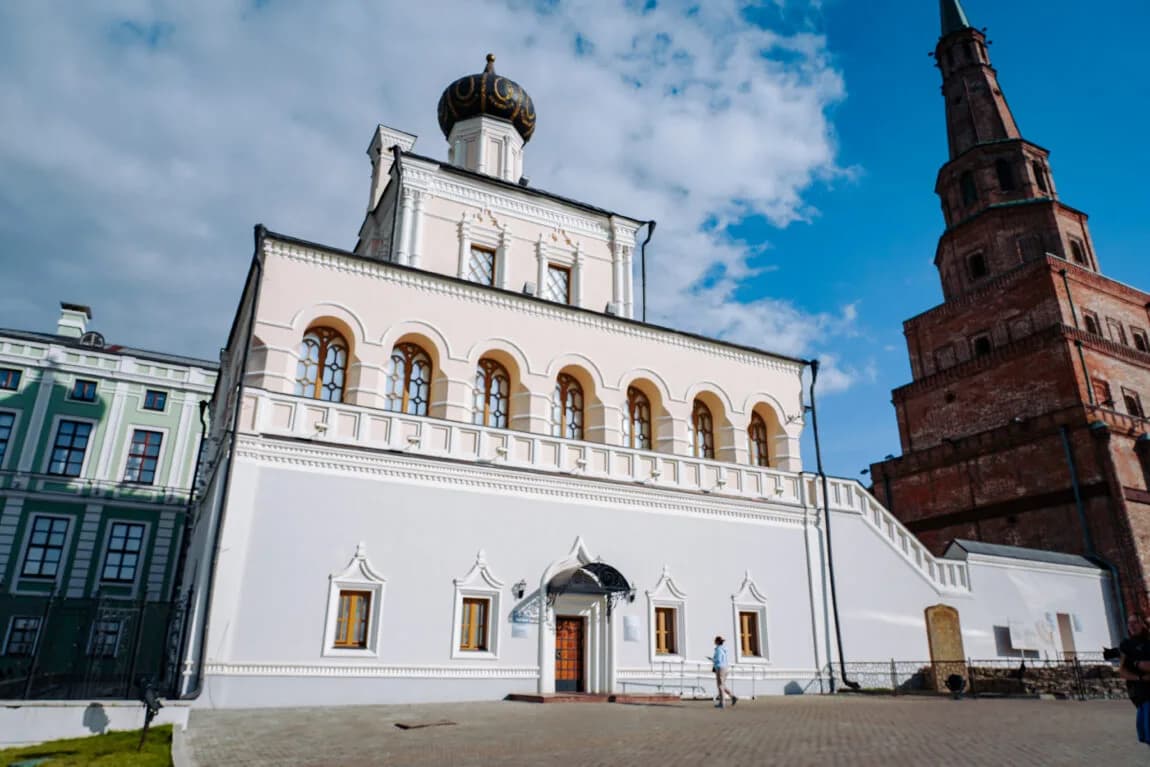
The Palace Church was built in the 17th century in the northern part of the Kazan Kremlin. One hypothesis argues that the church was built on the site of the former Nur‑Ali Mosque, which had stood there during the Khan’s period. The church was reconstructed in the 18th century and reconsecrated as Vvedenskaya Church. The walls were laid with large bricks and plastered. The church embodied the traditions of Russian Baroque.
The Vvedenskaya Church was a domestic chapel, intended for the use of the Kazan governor. The church services were led by a priest who lived in the palace, while the readers were invited from outside.
The church burnt down in 1749 but was rebuilt; however, after the fire of 1815, it was impossible to restore its original appearance. Until 1849, the surviving church buildings were used as a gunpowder store.
During a visit to Kazan in 1836, Emperor Nicholas I ordered that the burnt‑down church be restored and connected to the Governor's Palace, whose construction was also due to begin shortly. The church was restored as a palace church in the Governor's Palace.
In 1859, the church was dedicated to the Descent of the Holy Spirit upon the Apostles. The palace church in the name of the Descent of the Holy Spirit, with the chapel of the Holy Martyr Tsarina Alexandra, occupied the second floor, while on the ground floor there was a chapel in the name of St Nicholas the Wonderworker, the church icon of which was donated in the middle of the 19th century by Anna Davydovna Boratynskaya, a representative of the local nobility.
The church’s icons and liturgical vessels, created in the 19th century, were looted in 1918 and have not survived.
During the Soviet period, the church functioned as a canteen. Its interior decoration was lost.
The new church replicated the burnt‑down church's basic structural elements. The building has a pyramid shape and is composed of volumes of different sizes. Clusters of semi‑columns with ornate capitals adorn the corners of the volumes, while brick friezes run beneath the roof. The windows are decorated with graceful architraves with ‘cockscomb’ motifs. The gallery is embellished with shirinka (recessed square panels) and a series of rectangular ornamental projections.
The church is crowned with an onion dome resting on an octagonal drum, the corners of which are marked by semi‑columns. The onion dome is adorned with applied oak garlands and leaves along the ribs of its facets.
The church has an arched, enclosed gallery — an architectural feature borrowed from the terem (a traditional Russian upper‑floor chamber), of which few examples have survived to this day. The gallery was originally unglazed and consisted of a single U‑shaped balcony running along three sides of the central quadrangle. Later it was glazed and transformed into a bright corridor. The church was restored in 2002, and all the window frames were made openable. Although the church was no longer in use for worship, a UNESCO sign was installed on its dome. The sign was soon removed, so the dome now stands without either a sign or a cross.
The second floor of the church building now houses a permanent exhibition of the Museum of the History of the Tatar People and the Republic of Tatarstan. The ground floor houses the museum’s exhibition hall.