

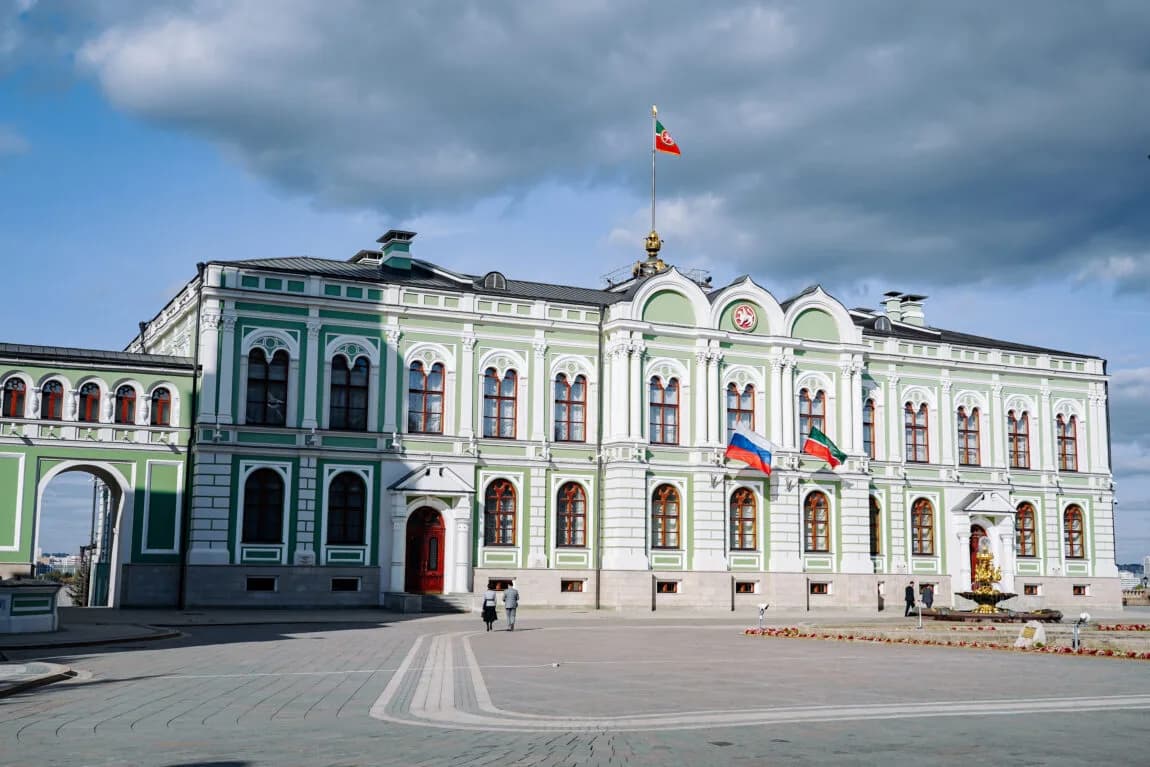
The Kazan Governor's Palace is located in the northern part of the Kazan Kremlin, on the site of the Khan’s court complex, which stood there during the Kazan Khanate period.
During his visit to Kazan in 1836, Emperor Nicholas I selected a location for the palace and ordered the construction of a ‘Military Governor’s House with an Imperial Apartment’ in the Kremlin.
The palace project was created by Moscow architect K.A. Ton, who also designed the Cathedral of Christ the Saviour and the Grand Kremlin Palace in Moscow. The palace's construction was supervised directly by architect A.I. Peske, who was sent from St. Petersburg to assist in the rebuilding of Kazan following the fire of 1842. The interior decoration was carried out by the architect M.P. Korinfsky.
The palace's construction took place from 1845 to 1848, after which work on the interior decoration was carried out. The first official event was held on 22 August 1851. Bricks manufactured in Kazan were used in the construction of the Governor's Palace. Until 1917, the palace was used by the Governor of Kazan for the conduct of governmental affairs.
The palace is a two-storey building, which includes the main building and adjacent service buildings. The building measures 56 by 40 metres and stands 28 metres tall.
The building has two entrances on its façade: porches, each supported by two columns with palm capitals. The first and second floors are articulated by a row of order pilasters and arched window openings. The façade is semicircular in plan and features a carriageway leading to the palace’s inner courtyard. The building's eclectic décor combines elements of Russian classicism, Baroque and Old Russian architecture.
During the imperial period, the palace's mezzanine floor housed the court servants' rooms. The floor below housed the Imperial apartments, the Imperial bedroom, a study, a dressing room and a reception hall — seventeen rooms in total. The ground floor was the Governor’s, with a bedroom, study, dressing room and several halls. The chancellery was located in the basement.
Following the February Revolution of 1917, the Kazan Soviet of Workers', Soldiers' and Peasants' Deputies was located in the Governor's Palace. On the night of 25–26 October 1917, a meeting of the revolutionary staff was held, at which Soviet power was proclaimed in Kazan. During the Soviet period, the Presidium of the Supreme Soviet and the Council of Ministers of the TASSR were located in this building.
The restoration of the building began in 1950. The main façade was restored in 1983 to a design by architect S.A. Kozlova, and the semicircular annex on the building's north side was restored in 1996–1997. By 2001, the building and its interiors had been completely restored.
Today this building is the residence of the Rais (Head) of the Republic of Tatarstan. The coat of arms of the Republic of Tatarstan with a white leopard is on the central risalit of the building's façade, while the presidential standard flies from its summit.