

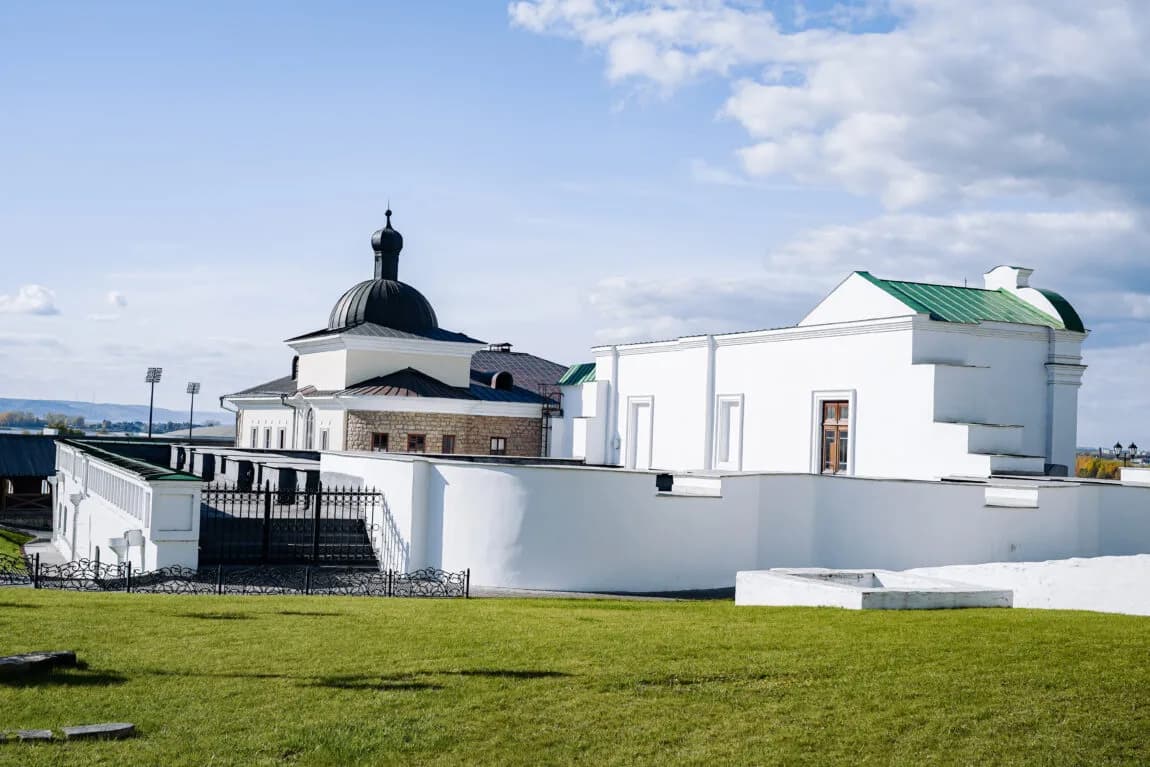
The cathedral is part of the complex of buildings of the Saviour's Transfiguration Monastery. Museumised archaeological fragments of the cathedral have survived to this day.
The Transfiguration Cathedral was built in the south‑western part of the Kazan Kremlin. The original wooden church on a white‑stone lower tier was constructed in the 1550s and named Preobrazhenskaya (Transfiguration Church). The first Archbishop of Kazan, Gurias, took monastic vows here and was buried behind the altar of the Transfiguration Cathedral on 5 December 1563; his grave became the first burial in the cemetery of the Saviour's Transfiguration Monastery. Later, famous priests and professors of the Kazan Theological Academy, merchants, military men and officials were buried here.
The wooden church burnt down in 1579, and a new stone, six‑pillared, five‑domed Transfiguration Cathedral with three altar apses (projections of the cathedral building housing the altar) was built on its site. The cathedral was erected on the surviving stone lower tier of the wooden church.
In the 18th century, galleries were added to the north and south walls of the Transfiguration Cathedral. A vaulted gulbishche (terrace) was attached on the south side at the level of the cathedral’s lower tier, and two‑storey galleries were added on the north side; their lower storey had cross vaults resting on large white‑stone trapezoidal skewbacks. The second storey of the gallery served as a corridor connecting the cathedral with the abbot’s house and the Church of St Nicholas Ratny (St Nicholas the Warrior). There was a large formal porch on the east side of the gallery.
In the middle of the 18th century, Archimandrite Theophilus Ignatovich raised the walls of the Transfiguration Cathedral, replaced the old domes on the barrel‑shaped roof with new ones — ‘on iron arches’ — and covered the church with iron for the first time.
In 1901, an extension spanning the entire width of the cathedral was added on the west side.
In the 1920s, the Saviour’s Transfiguration Cathedral was blown up.
Its foundation and the ‘cave’ have survived to this day. The site has been museumised.