

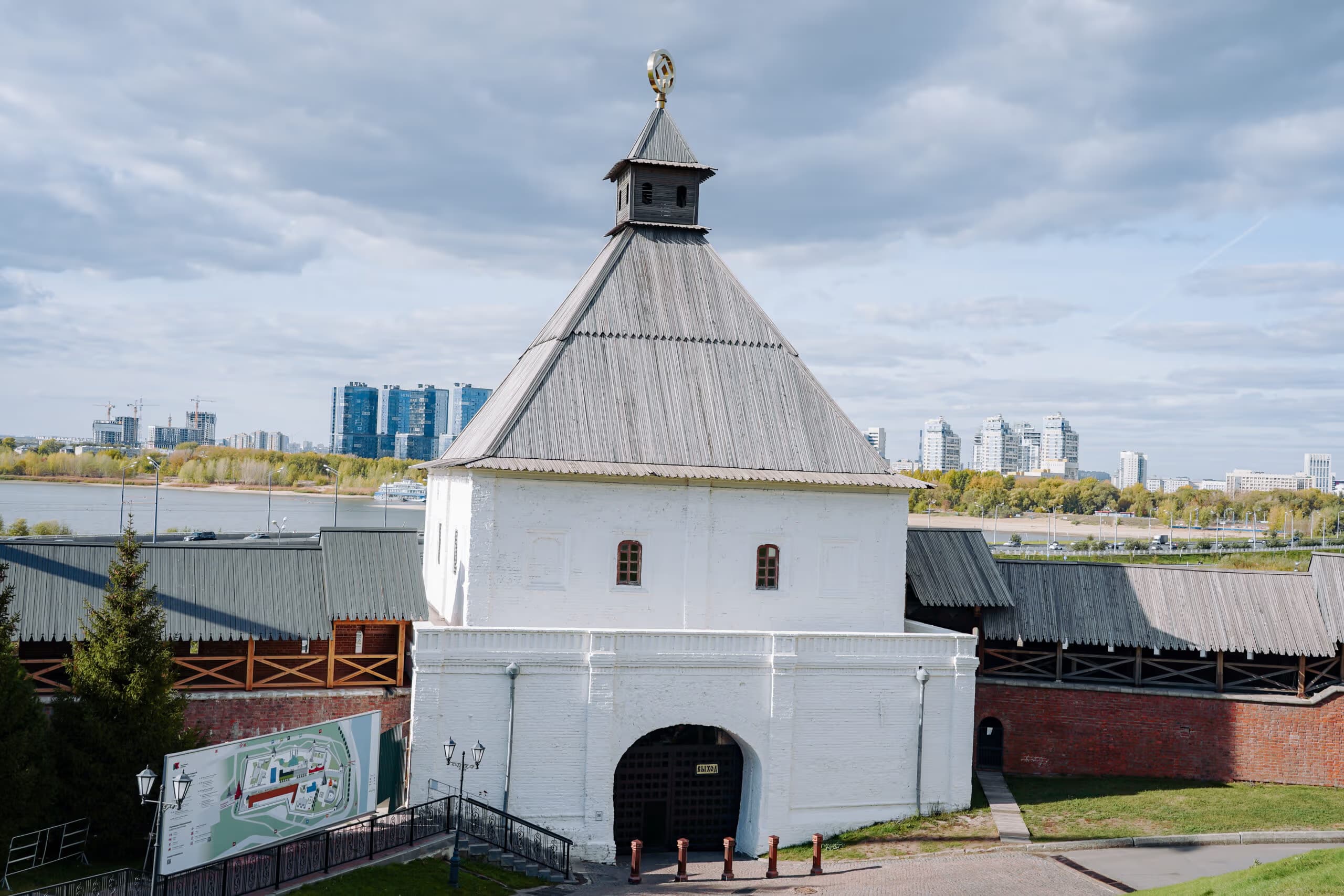
This gate tower was constructed in the second half of the 16th century by Ivan Shiryai and Postnik Yakovlev, two Pskov craftsmen, on the site of the Nur‑Ali Tower of the Khan’s fortress (called the Muralleeva Tower by Russians in the 16th century), which had been blown up during the siege.
The tower was given its first name from the Church of St Nicholas the Wonderworker and became known as Nikolskaya. Subsequently, the tower was renamed and became the Taynitskaya Tower because of its proximity to a cache that had been blown up – an underground passageway leading to the spring where the fortress's defenders obtained drinking water during the 1552 siege.
The rectangular brick tower was originally single-tiered, with a dog‑leg passage, and finished at the top with rectangular crenellations and a wooden four-sided hipped roof. The tower acquired its current appearance in the 18th century, when it became two-tiered tower. The passage connecting the first and second tiers is designed as a terrace with a stone parapet. The tower's loopholes faced the Kazanka River. The tower has a wooden hipped roof, with a guardhouse placed above it, and is topped by a rotating sign of the UNESCO World Heritage Committee.
The tower faced the threat of destruction at the beginning of the 19th century due to flooding of the Kazanka River; however, a massive buttress was built against the tower’s outer wall, allowing the monument to be preserved to this day.