

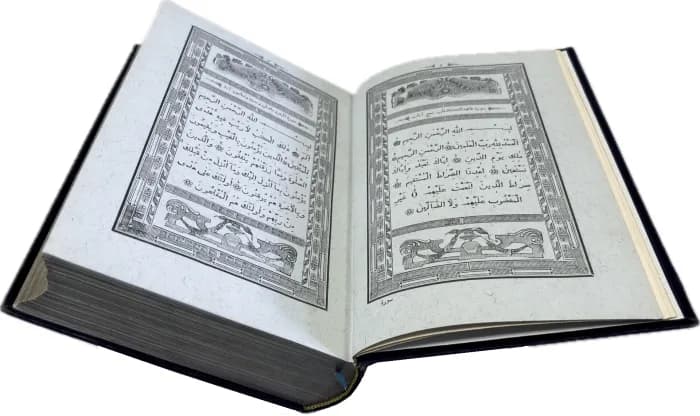
Kazan is the first city of mass printing of the Quran, and Kazan printing houses set the standard for modern printing of the holy book of Muslims. The exhibition aims to tell about the phenomenon of Kazan Qurans through 10 items from the collections of the Kazan Kremlin Museum-Reserve.
In the 19th and early 20th centuries, Kazan was the largest centre of Quran printing in the world. From 1803 to 1917, 165 print runs of the complete Quran, 188 print runs of the Haftiyak (selected surahs), and 108 pamphlets with individual surahs were published in Kazan. The total print run of all Kazan editions by 1919 exceeded several million copies.
The collection of Qurans in the collections of the Kazan Kremlin Museum-Reserve currently numbers more than 600 editions of the Arabic text of the Holy Book and its translations into the languages of the peoples of the world.
The historically significant part of the collection consists of Kazan editions of the Quran published in 1803–1919.


The following expression determines Kazan as the city of the first printed Quran in the Muslim World:
'The Quran was revealed in the Hijaz, recited in Cairo, written in Istanbul, and first printed by Muslims in Kazan.'
And this is indeed true: on the initiative of Gabdelgaziz Burashev and with the permission of Emperor Alexander I, the typesetting and publication of the Quran was completed in 1803 at the Asiatic Printing House of the Kazan Gymnasium. The book was printed in two versions: in two volumes and in ten volumes (for children).
This is the sixth volume of ten from the so-called 'children's' edition. The book is printed on blue manufactured paper. The ten-volume edition was intended specifically for children and was the first edition of the Quran of this kind. This series was published in a small format (that is, in a reduced size).
This Quran was printed in a print run of 1000 copies only once. Researchers have no information about additional print runs and editions of this kind.
According to the owner, the Quran comes from the library of a mullah of Buinsky Uyezd.
The book has been restored.


The first and subsequent Kazan editions of the Quran established the existing printed standard: the placement of text within a frame, numeric page numbering, simplicity of typeface, and the linearity of the printed text, among others. In addition, thanks to them, the practice spread of including at the end of the book the ‘khatma’ (prayer after completing the reading of the Quran), information on tajweed signs (rules of Quran recitation), and an index of surahs. All Kazan editions of the Quran had a text typeset.
This edition was financed by Yusuf Ismagilovich Apanaev. Book publishing was an expensive undertaking: the patron bore the costs of renting the printing house, paying various fees, purchasing paper, and binding the books. More than 20 benefactors are known to have financed Quran printing in Kazan printing houses.
For example, at various times the merchant Gubaydulla Yunusov, the townsman Fatkhulla Amashev, the hajji Shamseddin son of Khusain, Ibrahim son of Ishmurat, and many others donated their savings to the publication of the Holy Book. The names of the patrons were listed on the title page of the editions.


This Quran is entered in the Museum-Reserve's accession book under No. 1, that is, it is the first item from more than 22,000 storage units of the Kazan Kremlin accepted as a museum artefact.
Initially the Quran was published as a single volume of almost 500 pages. Later the edition was divided by the owner into 15 equal parts (2 juzs in each). The first volume before you contains 2 juzs, namely Surah al-Fatiha and 252 verses of Surah al-Baqarah.
Manufactured paper, blue. During rebinding, the owner trimmed the marginal comments, that is, the part of the book that lies outside the decorative frame.
This shows the utilitarian nature and the frequency of use of the Book.


Imams and authoritative scholars exercised control over the accuracy of the printed text of the Quran in Kazan printing houses: Shigabutdin Mardjani, Gabdelkayum Gabdelbadyig, Kamaletdin Kashavi, Galimzhan Barudi, Safiulla Chinbali and others. Their efforts improved text structure, the typesetting and the arrangement of the printed signs of tajweed.
The colophon (final page) of this edition states that the Quran was published under the supervision of Shigabutdin bin Bagautdin al-Mardjani — an outstanding Tatar religious figure, historian and enlightener.
The binding is leather with embossing. There is an ink note in Tatar in Arabic script recording that the book belonged to the deceased Gafifa, daughter of Muhammad-Zarif Kulieva.


During the 19th century, the printed version of the Quran was gradually improved: a title page appears at the beginning of the book, the texts of the surahs are enclosed in frames, and the title of the surah, the place of revelation and the number of verses are indicated separately. The end of the book contains the rules for prayer after completing the recitation of the Quran, an index of surahs and the publication details.
The book was bound in Lutsky’s bookbinding workshop in Kazan; a stamp impression in blue ink in Tatar on the inside of the cover indicates this. The cover is bound in velvet.
A surviving ownership inscription in ink in Tatar reads:
‘Quran belonging to Sufia Mustafina and her husband Gumar Karimov, 1966’.
(Sufia Mustafina was the Tatar scholar Sh. Mardjani’s great-granddaughter.)


The Quran before you came from Ivan Nikolayevich Kharitonov’s Printing House. People called him ‘the Tatar Gutenberg’ for his high printing quality, his improvements to Arabic typefaces and his artistic design of publications. Various printing houses in Kazan also published the Quran over the years: the Imperial Kazan Gymnasium and the Imperial Kazan University, N.P. Kokovin’s, the Chirkovs’ (S. M. and M. A.), L. Shevits’s, G. M. Vecheslav’s, B.L. Dombrovsky’s, the Karimov brothers’, I. N. Kharitonov’s, ‘Umid’ and others.
Note the upper cover below the book’s title. The cover depicts a grotesque in the form of a vessel, containing the 79th verse from Surah Al-Waqi‘ah, which states the need for ablution before reading the book. This composition was probably created by Galiaskar Kamal, later a famous writer and playwright, who worked for I. N. Kharitonov as a calligrapher, engraver and typesetter.


This Quran edition’s distinguishing feature is that the full text is printed in thirty separate parts. Historically, the Quran’s division into 30 equal parts, called juzs, is linked to the Ramadan tradition of reading the Holy Book — one part for each of the 30 fasting days.
The owner bound all 30 parts in separate covers, ordered a uniform binding from a special workshop, and also made a case for the entire collection.
Note the unvan — a rich decorative frame surrounding the book’s first spread, which contains Surah Al-Fatiha and the first verses of Surah Al-Baqarah. Its floral design draws inspiration from classical unvans in manuscript Qurans.


This Quran was printed at the Karimov brothers’ Printing House.
The Trading House owned by the Karimov brothers Sharifzyan, Mukhametzyan and Khasan was the most successful publishing and book selling complex in Tatar book culture’s history. Its owners financed publications themselves, printed books at their own printing house and sold them in their shops in Kazan, Orenburg and Ufa, as well as at major fairs. The Karimov brothers’ Printing House printed the Quran 17 times with various designs.
This book’s distinguishing feature is its custom-made binding. A Tatar inscription is engraved on the silver plate:
‘Dedication / To the highly respected Mr Ibrahim, son of Valiulla Teregulov / a gift from the patriots of the city of Ufa / in honour of the 30th anniversary of noble service / Ufa, 1878 – 1 July 1908’.


The exhibition concludes with two further items that, strictly speaking, are not Kazan Qurans but are closely connected with this phenomenon.
The item before you is a Quran translation into Russian made by G. S. Sablukov (1804–1880), Professor at the Kazan Theological Academy. The text block is oriented in the Muslim manner, from right to left, and combines the Arabic Quran text (the right-hand page in each spread) with a Russian translation (the left-hand page in each spread).
This translation’s first print run appeared in Kazan in 1878. The translation is regarded as faithful to the Quran’s meanings, since it was made directly from the Arabic text rather than from intermediary languages.
An interesting feature of Sablukov’s present translation is the absence of Arabic loanwords in the text, so it is understandable even to those unfamiliar with Islamic tradition and specialised terminology. This edition combines the Kazan Quran typesetting with a translation of the meanings into Russian.


Tatar diaspora communities abroad have made several successful attempts at reprint publication of the Quran based on Kazan editions: in Japan (1934), Finland (1943, 1969) and Turkey (1985).
We present the Tokyo reprint — the first printed Quran published in Japan in its original language. It was printed in 1934 with funds from Tatar-Bashkir communities in Tokyo, Kyoto and Seoul. The book reproduces a Quran published in Kazan in 1913.
Gabdulkhay Kurbangaliev, imam-mudarris and first leader of the Tatar community in Japan (1889–1972), participated in preparing the reprint.
The title page bears a handwritten inscription in brown ink in Arabic script in Tatar:
‘Ahmed Apanaev bought this Quran in 1940 for 10 yen at the Muslim Association of Great Japan.’


The Kazan Kremlin Museum-Reserve continues to collect, study and promote Quran editions published in Kazan. Many years of study resulted in publishing the catalogue ‘Kazan Quran Editions from the Kazan Kremlin Museum-Reserve Collection’ by N.G. Garaeva..
This catalogue’s materials were used in preparing the virtual exhibition.